
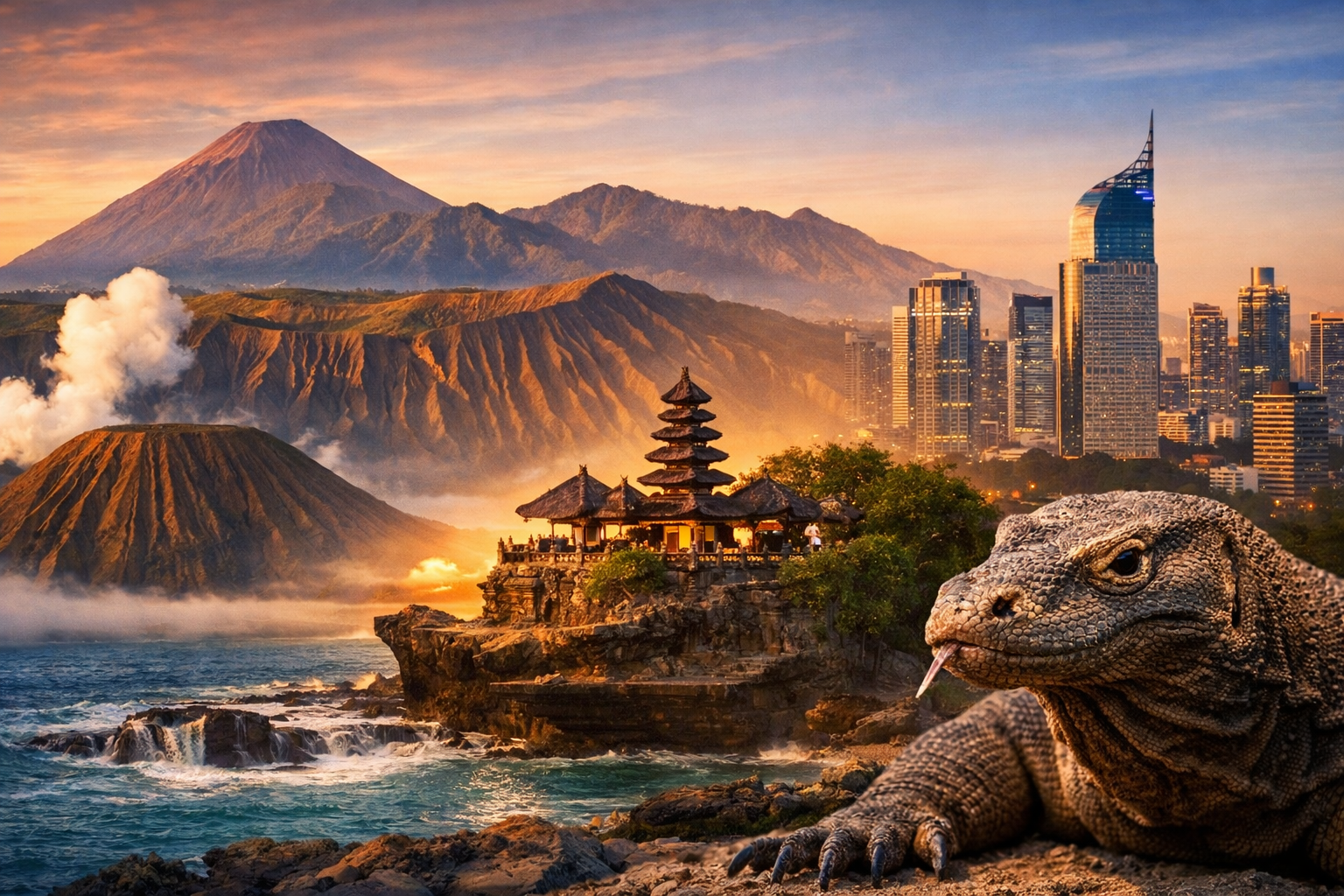
🇮🇩 One of the Asian Countries:
Indonesia
Asia is home to some of the world’s most diverse and fascinating nations. Among them, Indonesia stands out for its vast geography, cultural richness, and deep historical roots. Spread across thousands of islands, Indonesia is not just a country, it is a living mosaic of people, languages, landscapes, and traditions.
In this article, we explore Indonesia’s location, history, society, economy, and its growing role in the modern world.
🌏 Location and Geography
Indonesia lies in Southeast Asia and is the world’s largest archipelagic country. It stretches across the equator and connects two major oceans, the Indian Ocean and the Pacific Ocean.
The country consists of more than 17,000 islands, although only about 6,000 of them are inhabited. Some of the major islands are Sumatra, Java, Kalimantan (the Indonesian part of Borneo), Sulawesi, and Papua.
The capital city is located on the island of Java. Java is one of the most densely populated islands on Earth, yet it is also one of Indonesia’s economic and cultural centres.
Indonesia is famous for its dramatic natural features. It has:
- active volcanoes,
- long coastlines,
- tropical rainforests,
- coral reefs,
- and rich marine life.
This extraordinary natural variety makes Indonesia one of the world’s most important biodiversity regions.
🕰️ A Brief History
Indonesia’s history is deeply connected with trade, religion, and colonial rule. For centuries, the islands were part of important trade routes linking China, India, and the Middle East. Through these connections, Hinduism and Buddhism arrived early, followed later by Islam.
Two of the most famous historical monuments from the ancient period are and both located in central Java. These monuments clearly show how advanced Indonesian civilisation was more than a thousand years ago.
From the seventeenth century, the region gradually came under European control, mainly by the Dutch. Indonesia remained a Dutch colony for over three hundred years.
After a long struggle, Indonesia declared independence in 1945. In the decades that followed, the country worked hard to unite its many islands and ethnic groups into one nation.
👥 People, Languages, and Culture
Indonesia is one of the most culturally diverse countries in the world. More than three hundred ethnic groups live across its islands, each with its own customs, clothing styles, music, and local traditions.
The national language is Indonesian, also known as Bahasa Indonesia. It plays a very important role in bringing people together, because many communities still speak their own local languages at home.
Family and community life are central to Indonesian society. Festivals, weddings, and religious celebrations are often large and colourful public events that involve neighbours, relatives, and entire villages.
Traditional arts such as batik cloth-making, shadow puppet theatre (wayang), and regional dances continue to be practised widely, even in modern cities and tourist centres.
Religion also shapes daily life. Most Indonesians are Muslims, but there are also large Christian, Hindu, and Buddhist communities. This religious diversity is officially recognised by the state and can be seen in everyday public life.
🌋 Nature and Wildlife
Indonesia’s natural environment is one of its greatest treasures. The country sits on the Pacific Ring of Fire, which explains why it has many active volcanoes.
One of the most photographed landscapes in the country is famous for its sunrise views and wide volcanic plains.
Indonesia is also home to rare and unique wildlife. The most famous example is the Komodo dragon, the world’s largest living lizard, found in Rainforests in Sumatra and Borneo shelter orangutans, tigers, and many endangered species. At the same time, Indonesia’s coral reefs, especially in the eastern islands, are among the richest marine ecosystems on the planet.
🏝️ Tourism and Major Attractions
Tourism plays an important role in Indonesia’s economy. The island of is internationally famous for its beaches, temples, traditional dance, and warm, welcoming atmosphere.
Apart from Bali, travellers visit Indonesia to explore:
- ancient temples in Java,
- wildlife in national parks,
- diving sites in eastern Indonesia,
- and traditional villages in remote islands.
Tourism not only brings foreign income but also helps local communities preserve their cultural heritage, traditional crafts, and local knowledge.
💼 Economy and Development
Indonesia has one of the largest economies in Southeast Asia. Its economy is supported by agriculture, mining, manufacturing, tourism, and a fast-growing digital sector.
Major products include rice, palm oil, rubber, coffee, natural gas, and coal. In recent years, Indonesia has also focused strongly on infrastructure development such as roads, ports, and airports in order to better connect its many islands.
Many young Indonesians are now working in technology start-ups, online businesses, and creative industries. This youthful population is giving the country fresh energy and new ideas for future growth.
🌏 Indonesia in the World
Indonesia plays an active role in regional and international cooperation. It is a key member of the commonly known as ASEAN.
Because of its strategic location between major oceans and its large population, Indonesia is often seen as a bridge between Asia, the Pacific region, and the wider global community.
The country also regularly participates in international discussions on climate change, marine protection, and sustainable development, especially because its forests and oceans are vital for the planet’s environmental balance.
🌱 Challenges and the Road Ahead
Despite its progress, Indonesia faces several challenges. Environmental protection is one of the most serious. Deforestation, plastic pollution, and pressure on marine ecosystems threaten the country’s natural heritage.
Rapid urban growth, especially in large cities such as Jakarta, has created problems related to housing, traffic, and flooding. Education and health services must also continue to improve so that development benefits people in both cities and rural areas.
However, Indonesia’s strong sense of unity, cultural pride, and youthful population give it great potential to face these challenges with confidence.
📝 Conclusion
Indonesia is far more than a collection of beautiful islands. It is a nation shaped by centuries of trade, faith, struggle, and cooperation. From ancient temples and powerful volcanoes to busy modern cities and digital start-ups, Indonesia shows how tradition and modern life can exist side by side.
As one of Asia’s most diverse and dynamic countries, Indonesia continues to grow in confidence and influence. Its story is still being written, and in the years ahead, it is likely to remain an important voice in both the Asian region and the wider world.