
The Solar System
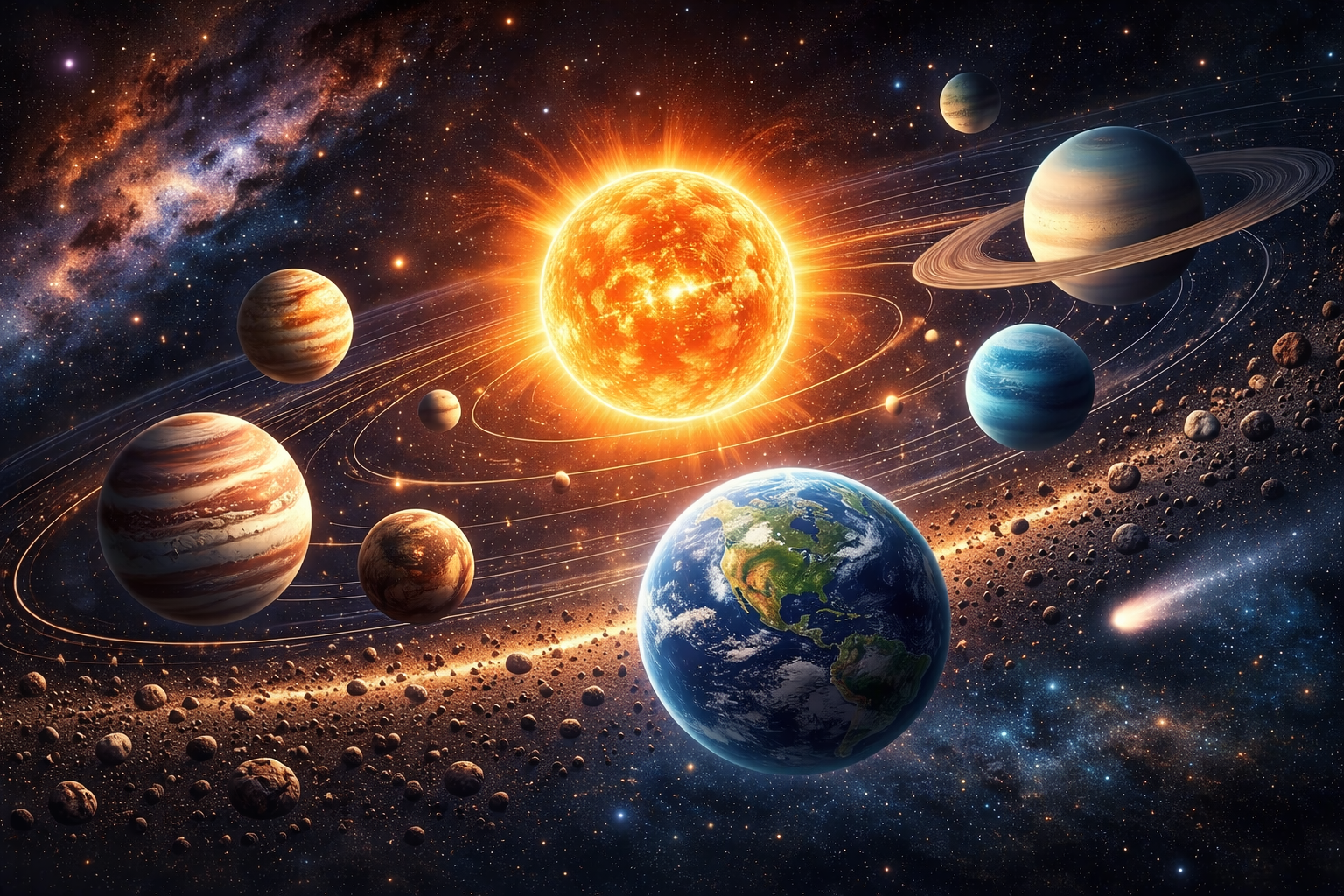
The Solar System is our local neighborhood in space. It is a vast and dynamic system made up of the Sun, eight planets, their moons, and countless smaller objects such as asteroids, comets, and dwarf planets. Everything in the Solar System is held together by gravity, with the Sun at the center acting as the main source of light, heat, and gravitational control.
Although the Solar System appears calm when viewed from a distance, it is constantly in motion. Planets travel along curved paths called orbits, moons revolve around their parent planets, and smaller bodies move through space on long and sometimes highly elliptical paths. The continuous movement of these objects reflects the powerful gravitational influence of the Sun.
Formation of the Solar System
The Solar System formed about 4.6 billion years ago from a massive cloud of gas and dust known as a molecular cloud. This cloud slowly collapsed under its own gravity. As it contracted, it began to rotate and flatten into a disk-shaped structure called a protoplanetary disk.
Most of the material gathered in the center of this disk and formed the Sun. The remaining matter spread throughout the disk and slowly combined through repeated collisions. This process, known as accretion, allowed small dust particles to grow into larger rocks, then into planetesimals, and eventually into full-sized planets and moons.
Temperature played a major role in determining the types of planets that formed. Near the young Sun, only rock and metal could remain solid. Farther away, where temperatures were much lower, ice and gases could survive. This difference explains why small rocky planets formed close to the Sun, while massive gas and ice giants developed farther out.
The Sun: The Center of the System
The Sun contains more than 99.8 percent of the total mass of the entire Solar System. It is a medium-sized star composed mainly of hydrogen and helium. At its core, nuclear fusion converts hydrogen into helium, releasing an enormous amount of energy.
This energy travels outward and reaches space as sunlight, providing heat and light to all the planets. Without the Sun’s steady energy output, life on Earth would not be possible.
The Sun’s gravity controls the motion of all objects in the Solar System. In addition, the Sun releases a continuous flow of charged particles called the solar wind. This solar wind shapes planetary atmospheres, creates auroras, and interacts with magnetic fields throughout the system.
The Inner Rocky Planets
The four planets closest to the Sun are Mercury, Venus, Earth, and Mars. These worlds are known as terrestrial or rocky planets because they are made primarily of rock and metal and have solid surfaces.
Mercury is the smallest planet and has almost no atmosphere. Its surface is heavily cratered and shows little evidence of geological change.
Venus is similar in size to Earth but has a dense atmosphere rich in carbon dioxide and clouds of sulfuric acid. A strong greenhouse effect makes Venus the hottest planet in the Solar System.
Earth is the only known planet that supports life. It has abundant liquid water, a protective magnetic field, and a stable atmosphere that allows a wide range of living organisms to survive.
Mars is known as the red planet because of iron-rich dust covering its surface. Scientific evidence suggests that Mars once had rivers, lakes, and possibly even oceans. Today, scientists continue to search for signs of ancient microbial life on this planet.
The Asteroid Belt
Between the orbits of Mars and Jupiter lies the main asteroid belt. It contains millions of rocky objects of various sizes, ranging from small fragments to bodies hundreds of kilometers wide.
These asteroids are leftovers from the early Solar System. They never combined to form a planet, largely because the strong gravitational influence of Jupiter disturbed their orbits and prevented stable growth.
Asteroids are valuable to scientists because they preserve ancient material that dates back to the formation of the Solar System.
The Giant Planets
Beyond the asteroid belt lie the four giant planets: Jupiter, Saturn, Uranus, and Neptune.
Jupiter is the largest planet in the Solar System. It is made mostly of hydrogen and helium and has an extremely strong gravitational field. Its atmosphere contains massive storms and colorful cloud bands.
Saturn is well known for its extensive ring system. Like Jupiter, it is a gas giant and has a large collection of moons.
Uranus and Neptune are classified as ice giants. They contain significant amounts of water, ammonia, and methane mixed with gas. Uranus rotates on its side, likely as the result of a major collision in the distant past.
Neptune is famous for having some of the fastest winds in the Solar System, reaching speeds of more than two thousand kilometers per hour.
Moons and Planetary Systems
Many planets possess complex systems of moons. Some of these moons are comparable in size to small planets and show remarkable geological activity.
Several moons are considered important targets in the search for life beyond Earth. Some are believed to contain oceans beneath icy surfaces, while others have thick atmospheres and active chemistry.
These discoveries have expanded scientific understanding of where life-supporting environments might exist in the universe.
Dwarf Planets and Small Bodies
In addition to the eight major planets, the Solar System contains a group of bodies known as dwarf planets. These objects orbit the Sun and are nearly spherical, but they have not cleared their orbital paths of other debris.
Many dwarf planets and icy objects are found in the Kuiper Belt, a region beyond the orbit of Neptune. Farther away, scientists believe a vast and distant reservoir called the Oort Cloud surrounds the Solar System.
Comets originate from these distant regions. When they approach the Sun, their ices heat up and form glowing tails that can be seen from Earth.
Asteroids and comets preserve some of the oldest material in the Solar System and provide valuable clues about its earliest history.
Ongoing Exploration
Space exploration has greatly improved our understanding of the Solar System. Robotic spacecraft now orbit planets, land on their surfaces, and study their atmospheres and geology in detail.
Some missions have returned samples to Earth, allowing scientists to analyze material directly in laboratories. Future missions aim to explore ocean-bearing moons, return samples from Mars, and study the formation of planetary systems around other stars.
Conclusion
The Solar System is a complex and evolving system shaped by gravity, solar energy, and physical processes that began billions of years ago. From the rocky planets close to the Sun to the icy objects at the distant edge of the system, every world contributes to the story of how our cosmic neighborhood formed.
By continuing to explore the Solar System, scientists gain a deeper understanding of Earth’s origins, the potential for life elsewhere, and humanity’s place in the universe.
