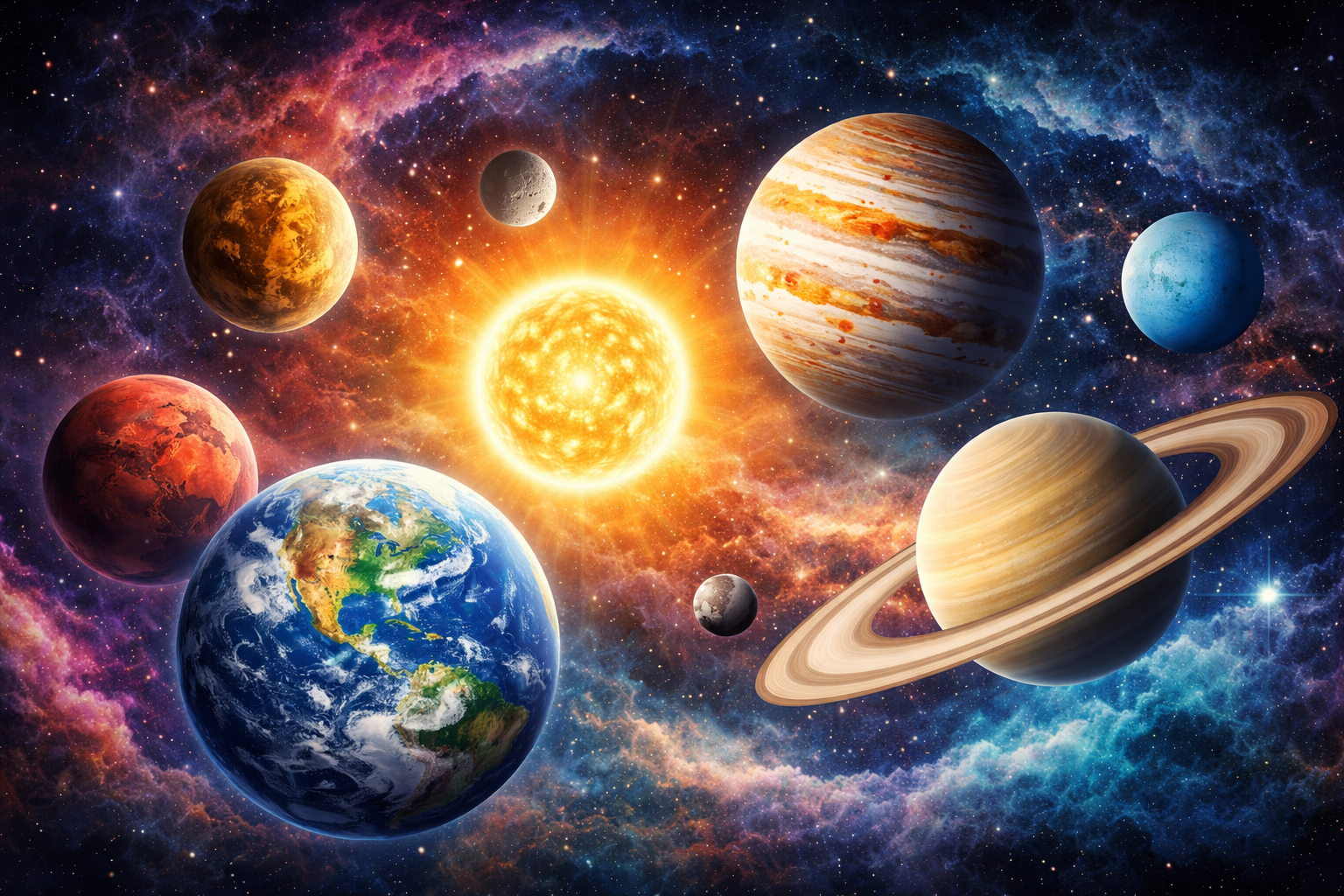
The Sun, Moon and Stars
A simple and factual article for General Knowledge improvement
The Sun, the Moon and the stars are the most familiar objects we see in the sky. From ancient times to modern science, humans have observed them to understand time, seasons, navigation and the structure of the universe. Although they appear similar when we look upward, they are very different in nature. This article explains what each of them is, how they affect our life on Earth, and why they are important for general knowledge.
The Sun
The Sun is the centre of our solar system. All the planets, including Earth, move around it. It is a huge ball of hot gases, mainly hydrogen and helium. Although the Sun looks small from Earth, it is extremely large. More than one million Earths could fit inside it.
The Sun produces energy through a process called nuclear fusion. In its core, hydrogen atoms join together to form helium. During this process, a tremendous amount of energy is released in the form of heat and light. This energy travels through space and reaches Earth in about eight minutes.
Life on Earth depends completely on the Sun. Sunlight keeps the planet warm enough for living organisms to survive. Plants use sunlight to make food through photosynthesis. Animals and humans depend on plants either directly or indirectly. Without the Sun, life on Earth would not be possible.
The Sun also controls the seasons. Because Earth is tilted on its axis, different parts of the planet receive different amounts of sunlight during the year. When a region receives more direct sunlight, it experiences summer. When it receives less, it experiences winter.
The Sun has visible features such as sunspots, which are darker and cooler areas on its surface. Sometimes powerful eruptions called solar flares occur. These release energy and charged particles into space. When such particles reach Earth, they can disturb satellites and radio communication and can also produce beautiful natural light displays near the polar regions.
Although the Sun feels gentle from our distance, it is a very active and powerful star. Studying the Sun helps scientists understand how stars behave throughout the universe.
The Moon
The Moon is Earth’s only natural satellite. It does not produce its own light. The light we see from the Moon is reflected sunlight.
The Moon plays an important role in Earth’s natural systems. One of its most noticeable effects is on ocean tides. The gravitational attraction between the Earth and the Moon causes sea levels to rise and fall each day.
The Moon takes about 27 days to orbit the Earth. However, the cycle of its changing shapes, called phases, takes about 29.5 days. These phases include the new moon, crescent moon, first quarter, full moon and last quarter. The changing appearance happens because we see different portions of the sunlit side of the Moon.
The Moon’s surface has no thick atmosphere, no liquid water on the surface and no weather such as rain or wind. As a result, its surface is covered with many impact craters. Large flat areas were formed long ago by volcanic activity.
An interesting fact about the Moon is that the same side always faces Earth. This happens because the Moon rotates on its axis in exactly the same time it takes to complete one orbit around our planet.
The Moon has influenced human culture, calendars and traditions for thousands of years. Many early civilizations used the Moon to measure time and plan farming activities. Scientific exploration of the Moon has also helped researchers understand the early history of the solar system.
The Stars
Stars are massive, glowing balls of hot gas, similar to the Sun. The main difference is that stars are extremely far away from Earth. Because of this great distance, they appear as tiny points of light in the night sky.
Stars produce their own energy through nuclear fusion in their cores. They vary greatly in size, temperature and brightness. Some stars are much larger and hotter than the Sun, while others are smaller and cooler.
On a clear night, thousands of stars can be seen without any telescope. In reality, our galaxy alone contains hundreds of billions of stars. The faint, cloudy band of light sometimes visible in the sky is made up of vast numbers of distant stars.
Stars are born inside huge clouds of gas and dust. Over time, gravity pulls the material together and a new star forms. A star spends most of its life changing hydrogen into helium. When its fuel begins to run out, the star changes depending on its size. Very large stars may end their lives in powerful explosions.
People have grouped stars into patterns known as constellations. These patterns were used by ancient travellers to navigate and by early cultures to create stories about the sky. Even today, constellations help observers locate objects in space.
By studying the light from stars, scientists can learn about their temperature, age and chemical composition. Observing stars also helps us understand how galaxies form and how the universe changes over time.
How the Sun, the Moon and the Stars are Different
The Sun is a star and is the main source of energy for our solar system. The Moon is a natural satellite that reflects sunlight and orbits the Earth. The stars seen at night are distant suns located far outside our solar system.
The Sun strongly influences Earth’s climate and supports life. The Moon mainly affects ocean tides and helps stabilize Earth’s rotation. The stars allow scientists to study the universe on a much larger scale.
Conclusion
The Sun, the Moon and the stars are essential parts of the sky we see every day. The Sun provides light and life, the Moon shapes natural cycles on Earth, and the stars reveal the enormous size and beauty of the universe.
Learning about these three celestial objects improves general knowledge and builds a strong foundation for understanding space and astronomy. When we look at the sky, we are not only seeing beautiful lights but also powerful natural systems that have shaped Earth and the universe for billions of years.