
Planets
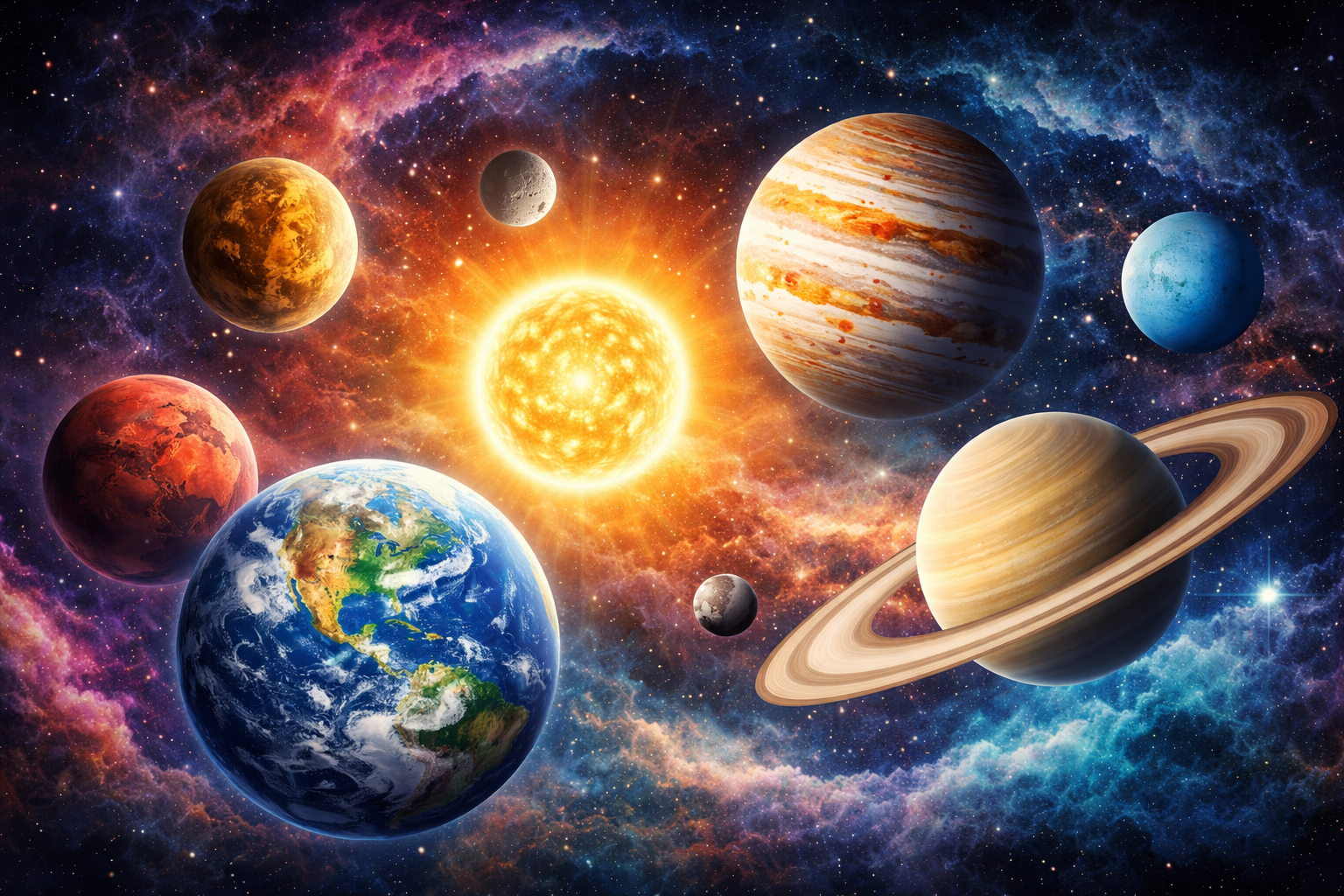
Our home in space is part of a large family called the Solar System. At the centre of this system is the Sun, and moving around it are eight main planets. A planet is a large natural body that goes around a star, does not produce its own light, and becomes almost round because of its own gravity.
In this article, we will explore what planets are, how they are grouped, and learn the main facts about all eight planets of our Solar System.
What is a planet?
A planet is a body in space that:
- revolves around the Sun
- has enough gravity to become almost spherical
- has cleared most other objects from its orbital path
Planets do not shine by themselves. They reflect sunlight. Each planet is different in size, temperature, surface and atmosphere, which makes our Solar System a fascinating subject of study.
Scientists divide the planets into two main groups:
- Inner (rocky) planets
- Outer (giant) planets
Inner planets (Terrestrial planets)
The four planets closest to the Sun are called inner planets. They are mainly made of rock and metal and have solid surfaces.
Mercury
Mercury is the closest planet to the Sun and also the smallest planet in the Solar System. Because it is so close to the Sun, its surface becomes extremely hot during the day. At night, the temperature drops sharply and becomes very cold.
Mercury has a heavily cratered surface, much like the Moon. It has almost no atmosphere, so heat cannot be trapped. An interesting fact is that although Mercury is closest to the Sun, it is not the hottest planet.
Venus
Venus is often called Earth’s sister planet because its size is very similar to Earth. However, its environment is completely different. Venus has a very thick atmosphere made mainly of carbon dioxide.
This thick atmosphere causes a powerful greenhouse effect, trapping heat and making Venus the hottest planet in the Solar System. Its surface temperature is hot enough to melt lead. Venus also rotates very slowly and in the opposite direction compared to most other planets.
Earth
Earth is the only known planet that supports life. It has liquid water, a suitable temperature range and an atmosphere rich in oxygen and nitrogen.
About seventy percent of Earth’s surface is covered by water. The presence of water, a protective atmosphere and a stable climate make Earth unique in our Solar System. Earth takes one year to complete one revolution around the Sun and one day to rotate once on its axis.
Mars
Mars is known as the Red Planet because of iron oxide in its soil. It has the largest volcano in the Solar System, called Olympus Mons.
Scientists are very interested in Mars because signs of ancient rivers and lakes suggest that water once existed there. Today, Mars is cold and dry, but robotic missions continue to search for evidence of past life.
Outer planets (Giant planets)
The four outer planets are much larger and are mostly made of gas and ice. They also have many moons and ring systems.
Jupiter
Jupiter is the largest planet in the Solar System. It is a gas giant made mostly of hydrogen and helium. One of its most famous features is the Great Red Spot, a huge storm that has been active for hundreds of years.
Jupiter has a very strong gravitational pull and plays an important role in protecting the inner planets by attracting or deflecting many comets and asteroids.
Saturn
Saturn is best known for its beautiful and wide ring system. These rings are made of ice particles, dust and rock fragments.
Like Jupiter, Saturn is a gas giant. It has a very low density. If there were a large enough ocean, Saturn could float on it. Saturn also has many moons, some of which are important targets for future scientific research.
Uranus
Uranus is an ice giant with a blue-green colour caused by methane in its atmosphere. What makes Uranus special is its extreme tilt. It rotates almost on its side.
Because of this tilt, each pole of Uranus experiences very long seasons. Some parts of the planet receive sunlight continuously for many years, while others remain in darkness for the same length of time.
Neptune
Neptune is the farthest planet from the Sun. It is also an ice giant and has a deep blue colour. Neptune is famous for having the strongest winds in the Solar System. Some winds there blow faster than any storms found on Earth.
Even though it is very distant and cold, Neptune is an active planet with powerful storms and changing cloud patterns.
Important differences between inner and outer planets
The inner planets are small, rocky and dense. They have solid surfaces and fewer moons. The outer planets are much larger, mostly made of gas and ice, and have ring systems and many moons.
Another important difference is their distance from the Sun. Inner planets receive more heat and light, while outer planets remain cold and dark.
Why are planets important to study?
Studying planets helps scientists understand how our Solar System was formed and how Earth became suitable for life. By comparing different planetary environments, scientists can learn how atmospheres develop, how climates change and how geological processes work.
Planetary research also supports the search for life beyond Earth. Understanding our own planets is the first step toward understanding planets around other stars.
Conclusion
The eight planets of our Solar System show us how diverse and dynamic space can be. From the burning surface of Venus to the icy winds of Neptune, every planet tells a different story about the history of our cosmic neighbourhood.
Learning about planets does not only improve general knowledge. It also helps us realise how special and carefully balanced our own planet is. Earth remains the only place we know where life can exist, and by studying other planets, we better understand how to protect and value our home in space.
